
Integrating Environmental Inputs with Nutrition for Metabolic Health
The Blank Slate Diet™ and the R.E.S.T.™ Protocol
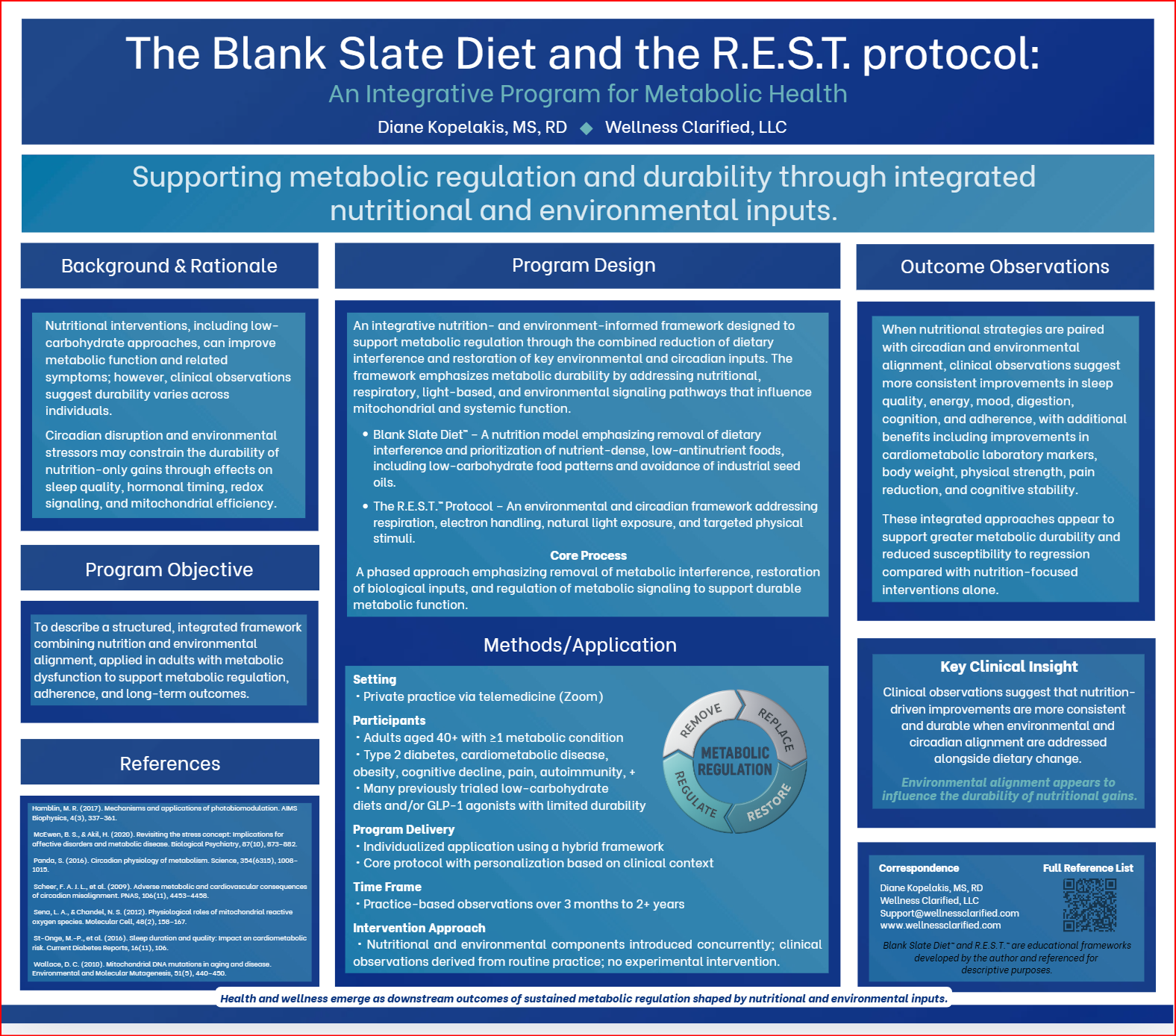
Metabolic health is shaped by more than diet alone. Emerging research in circadian biology, sleep physiology, mitochondrial function, and environmental signaling suggests that modern lifestyle factors may influence the durability of nutrition-driven improvements, particularly in adults with metabolic dysfunction.
This page provides the scientific context and clinical rationale supporting the framework presented at the SMHP poster session.
What This Framework Is
A practice-informed, non-experimental model
Integrates nutrition with circadian and environmental inputs
Designed to support metabolic regulation and durability
Grounded in existing literature across:
Circadian biology
Sleep and cardiometabolic risk
Mitochondrial signaling
Environmental stress physiology
Photobiomodulation
Framework Components
The Blank Slate Diet™
A nutrition approach emphasizing:
Removal of dietary interference
Reduction of antinutrients and inflammatory inputs
Prioritization of nutrient density
Stabilization of metabolic signaling
The R.E.S.T.™ Protocol
Respiration
Supports mitochondrial oxygen utilization and energy production
Electrons
Addresses environmental factors that influence redox balance and cellular signaling
Sunshine
Reinforces circadian timing, hormonal rhythms, and neuroendocrine regulation
Therapies
Targeted physical inputs (cold, light, grounding, movement) to support mitochondrial and nervous system signaling
Observed Clinical Themes
Across applied cases in private practice, patterns suggested:
Greater consistency of symptom improvement
Improved adherence and stability
Reduced relapse after plateaus
Enhanced durability when environmental inputs were prioritized
These observations align with existing mechanistic literature, though formal trials are needed.
Key Clinical Insight:
Clinical observations suggest that nutrition-driven improvements are more consistent and durable when environmental and circadian alignment are addressed alongside dietary change.
Environmental alignment appears to influence the durability of nutritional gains.
Future Directions:
Further study is warranted to assess longer-term outcomes and durability of integrated nutrition and environmental approaches.
Blank Slate Diet™ and R.E.S.T.™ are educational frameworks developed by the author and presented for descriptive and educational purposes.
Extended References & Supporting Literature
This page provides the extended reference list supporting the concepts discussed in the poster presentation:
“Health and wellness emerge as downstream outcomes of sustained metabolic regulation supported by nutritional and environmental inputs.”
The references below reflect established research in circadian biology, metabolic regulation, mitochondrial physiology, sleep, stress, aging, and environmental influences relevant to metabolic health.
Circadian Rhythm, Light Exposure, and Metabolic Health
Panda, S. (2016). Circadian physiology of metabolism. Science, 354(6315), 1008–1015. https://doi.org/10.1126/science.aah4967
Scheer, F. A. J. L., Hilton, M. F., Mantzoros, C. S., & Shea, S. A. (2009). Adverse metabolic and cardiovascular consequences of circadian misalignment. Proceedings of the National Academy of Sciences, 106(11), 4453–4458. https://doi.org/10.1073/pnas.0808180106
St-Onge, M.-P., Grandner, M. A., Brown, D., Conroy, M. B., Jean-Louis, G., Coons, M., & Bhatt, D. L. (2016). Sleep duration and quality: Impact on cardiometabolic health. Current Diabetes Reports, 16(11), 106. https://doi.org/10.1007/s11892-016-0796-4
Stress Physiology, Neuroendocrine Regulation, and Metabolic Disease
McEwen, B. S., & Akil, H. (2020). Revisiting the stress concept: Implications for affective disorders and metabolic disease. Biological Psychiatry, 87(10), 873–882. https://doi.org/10.1016/j.biopsych.2019.10.010
McEwen, B. S. (2017). Neurobiological and systemic effects of chronic stress. Chronic Stress, 1, 1–11. https://doi.org/10.1177/2470547017692328
Mitochondrial Function, Redox Biology, and Aging
Wallace, D. C. (2010). Mitochondrial DNA mutations in disease and aging. Environmental and Molecular Mutagenesis, 51(5), 440–450. https://doi.org/10.1002/em.20586
Sena, L. A., & Chandel, N. S. (2012). Physiological roles of mitochondrial reactive oxygen species. Molecular Cell, 48(2), 158–167. https://doi.org/10.1016/j.molcel.2012.09.025
Picard, M., Wallace, D. C., & Burelle, Y. (2016). The rise of mitochondria in medicine. Mitochondrion, 30, 105–116. https://doi.org/10.1016/j.mito.2016.07.003
Environmental and Physical Inputs Supporting Metabolic Regulation
Hamblin, M. R. (2017). Mechanisms and applications of photobiomodulation. AIMS Biophysics, 4(3), 337–361. https://doi.org/10.3934/biophy.2017.3.337
Tipton, M. J., Collier, N., Massey, H., Corbett, J., & Harper, M. (2017). Cold water immersion: Kill or cure? Experimental Physiology, 102(11), 1335–1355. https://doi.org/10.1113/EP086283
Metabolic Adaptation and Durability
Hall, K. D., & Guo, J. (2017). Obesity energetics: Body weight regulation and the effects of diet composition. Gastroenterology, 152(7), 1718–1727. https://doi.org/10.1053/j.gastro.2017.01.052
Dulloo, A. G., Jacquet, J., & Montani, J.-P. (2012). Adaptive thermogenesis in human body weight regulation. Obesity Reviews, 13(2), 105–121. https://doi.org/10.1111/j.1467-789X.2011.00952.x
Disclosure
The Blank Slate Diet™ and R.E.S.T.™ Protocol are educational frameworks developed by the author to integrate established scientific principles of nutrition, circadian biology, and environmental health. No experimental intervention or randomized trial data are presented on this page.
Correspondence
Diane Kopelakis, MS, RD
Wellness Clarified, LLC
📧 Diane@wellnessclarified.com
THANK YOU FOR VISITING!